


Business Incorporation

OTHER JURISDICTIONS ▶

What requirements do i need to incorporate my company in Singapore?

Your company name needs to be approved before registration.

You need to appoint a minimum of one resident* director. An unlimited number of additional resident or non-resident directors can be appointed as well. Both resident and non-resident directors need to be at least 18 years old, not bankrupt, and free of any malpractice charges in the past.

You can have anywhere between 1-50 shareholders, which may or may not be directors. Shareholders can consist of both local and non-local individuals or companies, and 100% non-local shareholding is allowed. After a Singapore company is incorporated, shares can be freely issued or transferred at any time.

You need to appoint a qualified resident* company secretary within 6 months of your Singapore company’s registration. Sole directors and/or shareholders cannot act as the company secretary.

You need to possess a minimum of S$1 worth of paid-up capital (also known as share capital) to register your Singapore company. This amount can be increased any time after your company is incorporated.

You need to provide a local, physical Singapore address as the registered address of the company. The registered address can be either a residential or commercial address, but not a P.O. Box.

Singapore-registered companies enjoy attractive tax exemptions and incentives. Your company pays less than 9% for the first S$300,000 you make in annual profits, followed by a flat rate of 17% flat thereafter. Singapore companies do not have to pay capital gains or dividend taxes. For further information on taxes, refer to our Singapore corporate tax guide.

*Refers to a Singapore Citizen, Permanent Resident, or holders of Singapore work visas (EntrePass or Employment Pass)


If you are not a Singapore resident and would like to incorporate a Singapore company, what requirements do you need?

You must engage a professional firm to register your Singapore company – under Singaporean law, non-resident individuals or entities cannot self-register a company.

You are not required to obtain a Singapore work visa to incorporate a private limited company if you are operating your company from overseas. You can visit Singapore on a visitor visa when you need to attend to company matters on a short-term basis. However, in such cases, you will need to find a local director to fulfil the minimum one resident director requirement. We can elect a nominee local resident director on your behalf – visit our services page to find out more.

All Singapore company registration and work permit formalities can be handled without you having to physically visit Singapore – unless you intend to open a bank account at a Singapore-based bank.


What documents are required to register my Singapore company?

To register your company in Singapore, you’ll need to provide the following documents:

Company name

Brief description of business activities

Shareholders’ particulars

Directors’ particulars

Registered address

Company secretary particulars

Constitution


If you are engaging the services of a professional service firm, they will typically require these documents from you in order to prepare the necessary paperwork:

For non-residents: Copy of passport, proof of overseas residential address, as well as other Know-Your-Client (KYC) information such as bank reference letters, personal and business profiles, etc.

For Singapore residents: Copy of Singapore identity card For corporate entity shareholder(s): Copy of registration documents, such as a Certificate of Incorporation and Constitution

Do note that officially-endorsed translated versions must be provided for any non-English documents.
Singapore Variable Capital Company VCC

Transforming a small sovereign country in Asia into a financial powerhouse

The Singaporean Variable Capital Company Act, or VCC Act, is one of the most significant developments in Asian finance to occur in recent years. Administered by the Accounting and Corporate Regulatory Authority of Singapore (ACRA), this legislation opens an entirely new world for foreign and domestic funds seeking to incorporate Asian investment instruments into their portfolios.

Offering a highly flexible fund structure, the VCC is poised to solidify Singapore’s position as the de facto financial and investment capital of Asia. First piloted in 2019 with the inclusion of 18 fund managers, the VCC Act officially went live on January 15th, 2020. Launching or redomiciling a VCC in Singapore is a straightforward process that is doable via the ACRA website. To ease the financial burden of registration, the Monetary Authority of Singapore (MAS) has launched a Variable Capital Companies Grand Scheme program.
This program will co-fund up to 70% of incorporation or registering expenses, so long as they are paid to a Singapore-based service provider.

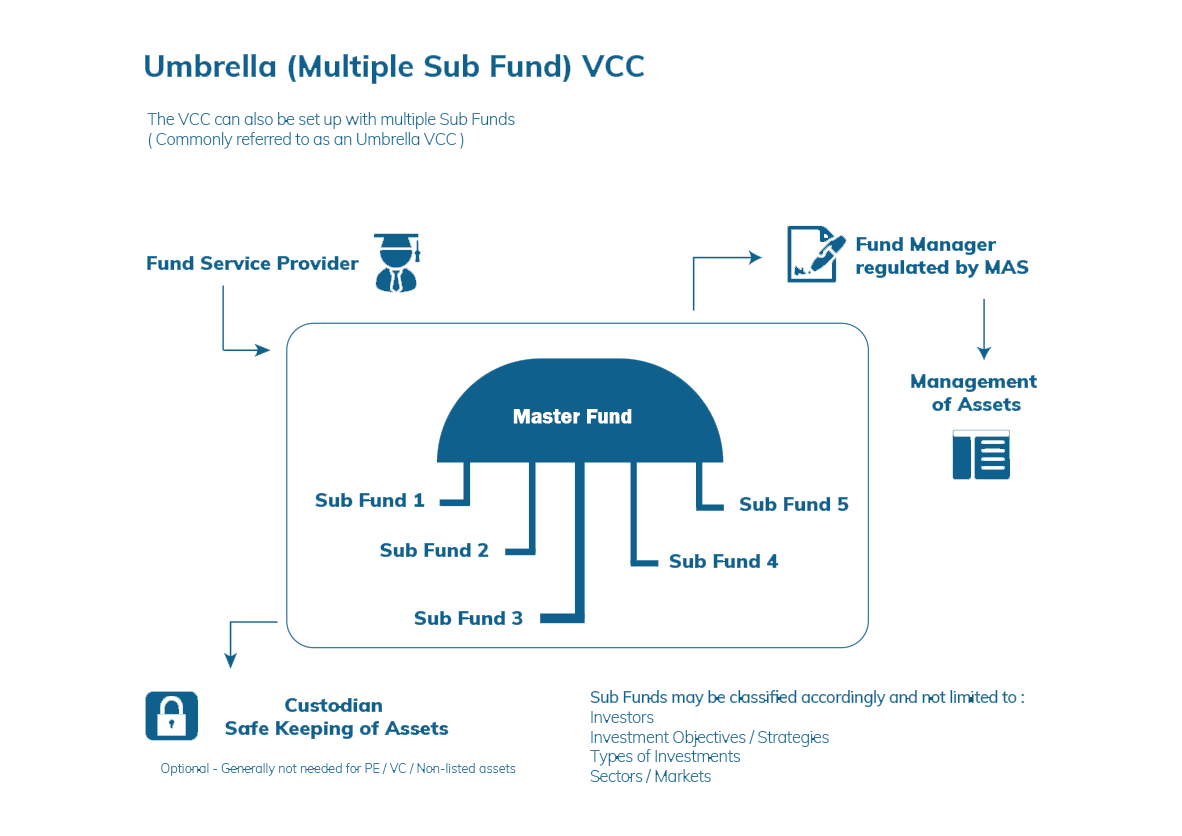
One of the most attractive benefits of using the VCC structure is the ability to issue a fund as a stand-alone entity or an umbrella entity. The former is comprised of a single investment portfolio and is a relatively traditional format for a fund. A VCC umbrella fund is much more dynamic and allows investors to issue various segregated sub-funds, all held under the same umbrella investment fund. Part 4, Subsection 29 of the VCC Act, is one of the essential sections of the Act that touches on umbrella funds.

This section states that the segregation of sub-funds means that the liabilities are self-contained to each specific sub-fund. If one sub-fund goes under, the other sub-funds within the same umbrella fund are not affected.

Both open and closed funds are available for registration under the new VCC Act. Open-ended funds can issue an unlimited number of shares, which are generally priced daily based on the fund’s net asset value (NAV). Open-ended funds are usually more liquid and hold diversified portfolios. Close-ended funds raise a fixed amount of capital and publicly trade on secondary markets. This fund style generally entails higher yields than their open-ended counterparts and are priced more frequently than once per day. Each of these fund styles has relative pros and cons, and Singapore’s VCC Act allows investors exposure to both types.

The United States represents a significant portion of the investment world. With portfolios becoming increasingly globalized, any legal framework is well-advised to consider how to incorporate US investors with relative ease. Bringing previously off-shore capital into on-shore funds is often best accomplished using the “check the box” rules associated with IRS Form 8832. These rules allow entities to be treated by the US as “pass-through” entities, offering US investors an enticing level of inclusion. While the legislation is still young, Singapore’s VCC Act allows US investors to take advantage of this attractive election opportunity.

Investors may wish to make the permanent move and redomicile in Singapore, given its emerging status as the de facto entry point to Asian financial markets. If a company is already doing business in Singapore, redomiciling allows for complete business continuity and confers many tax benefits. It is important to note that redomiciling in Singapore is irrevocable as there are currently no provisions for entities incorporated in Singapore to redomicile overseas.

While this means redomiciling is a permanent decision, the VCC Act demonstrates that the city state’s financial environment is further liberalizing, conferring both business and legal benefits for any entities that decide to redomicile in Singapore.

If a company is already doing business in Singapore, redomiciling allows for complete business continuity confers many tax benefits.

The subject of taxation naturally entails bilateral and multilateral trade agreements, of which Singapore has many. Singapore beats out most other nations in terms of tax treaties with 86 in its jurisdiction. This amount compares to 83 tax treaties in Luxembourg, 74 in Ireland, and 37 in Hong Kong. Any potential investor must consider the tax treaty benefits conferred by incorporating or redomiciling in Singapore as a second-order benefit. The OECD’s Base Erosion of Profit Shifting (BEPS) initiative focuses on eradicating predatory tax rate shopping by international corporations, and Singapore is a dedicated signer of this initiative. Notwithstanding this further demonstrates the veracity of the VCC Act and Singapore’s earnest approach to confidently stepping up to the plate as the new financial doorway to Asia.

The VCC Act takes the best aspects of other tax havens’ financial frameworks and optimizes them Singapore’s unique situation. This Act comes at a near-perfect time as the city-state is poised to receive massive investment from off-shore funds seeking to redomicile as on-shore entities due to geopolitical uncertainties. Many considerations must be taken into account before a company decides to expand into a new legal jurisdiction.

However, with Singapore’s dedication to Common Law, near-perfect position in the Strait of Malacca, and increasing economic liberalization, one would be hard-pressed to find a better candidate for foreign investment.