

Singapore Variable Capital Company VCC

Transforming a small sovereign country in Asia into a financial powerhouse

The Singaporean Variable Capital Company Act, or VCC Act, is one of the most significant developments in Asian finance to occur in recent years. Administered by the Accounting and Corporate Regulatory Authority of Singapore (ACRA), this legislation opens an entirely new world for foreign and domestic funds seeking to incorporate Asian investment instruments into their portfolios.

Offering a highly flexible fund structure, the VCC is poised to solidify Singapore’s position as the de facto financial and investment capital of Asia. First piloted in 2019 with the inclusion of 18 fund managers, the VCC Act officially went live on January 15th, 2020. Launching or redomiciling a VCC in Singapore is a straightforward process that is doable via the ACRA website. To ease the financial burden of registration, the Monetary Authority of Singapore (MAS) has launched a Variable Capital Companies Grand Scheme program.
This program will co-fund up to 70% of incorporation or registering expenses, so long as they are paid to a Singapore-based service provider.

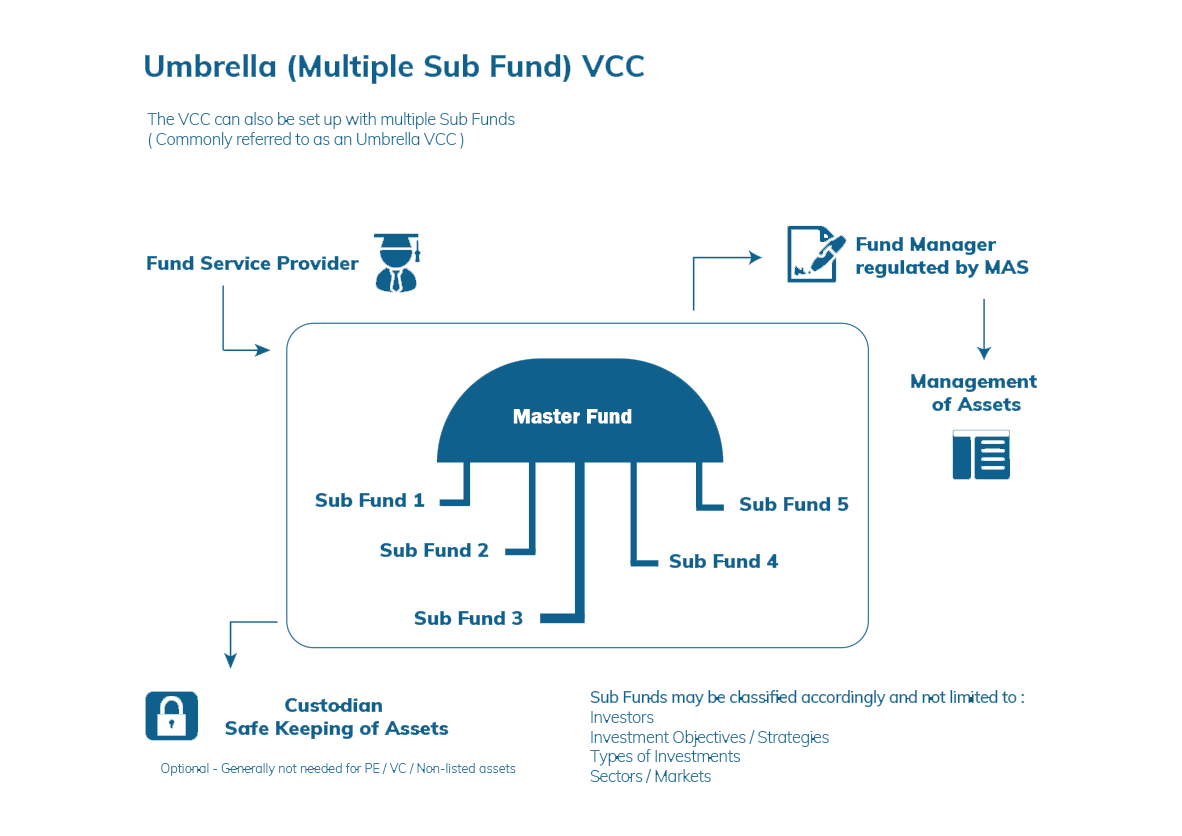
One of the most attractive benefits of using the VCC structure is the ability to issue a fund as a stand-alone entity or an umbrella entity. The former is comprised of a single investment portfolio and is a relatively traditional format for a fund. A VCC umbrella fund is much more dynamic and allows investors to issue various segregated sub-funds, all held under the same umbrella investment fund. Part 4, Subsection 29 of the VCC Act, is one of the essential sections of the Act that touches on umbrella funds.

This section states that the segregation of sub-funds means that the liabilities are self-contained to each specific sub-fund. If one sub-fund goes under, the other sub-funds within the same umbrella fund are not affected.
Both open and closed funds are available for registration under the new VCC Act. Open-ended funds can issue an unlimited number of shares, which are generally priced daily based on the fund’s net asset value (NAV). Open-ended funds are usually more liquid and hold diversified portfolios. Close-ended funds raise a fixed amount of capital and publicly trade on secondary markets. This fund style generally entails higher yields than their open-ended counterparts and are priced more frequently than once per day. Each of these fund styles has relative pros and cons, and Singapore’s VCC Act allows investors exposure to both types.

The United States represents a significant portion of the investment world. With portfolios becoming increasingly globalized, any legal framework is well-advised to consider how to incorporate US investors with relative ease. Bringing previously off-shore capital into on-shore funds is often best accomplished using the “check the box” rules associated with IRS Form 8832. These rules allow entities to be treated by the US as “pass-through” entities, offering US investors an enticing level of inclusion. While the legislation is still young, Singapore’s VCC Act allows US investors to take advantage of this attractive election opportunity.

Investors may wish to make the permanent move and redomicile in Singapore, given its emerging status as the de facto entry point to Asian financial markets. If a company is already doing business in Singapore, redomiciling allows for complete business continuity and confers many tax benefits. It is important to note that redomiciling in Singapore is irrevocable as there are currently no provisions for entities incorporated in Singapore to redomicile overseas.

While this means redomiciling is a permanent decision, the VCC Act demonstrates that the city state’s financial environment is further liberalizing, conferring both business and legal benefits for any entities that decide to redomicile in Singapore.

If a company is already doing business in Singapore, redomiciling allows for complete business continuity confers many tax benefits.

The subject of taxation naturally entails bilateral and multilateral trade agreements, of which Singapore has many. Singapore beats out most other nations in terms of tax treaties with 86 in its jurisdiction. This amount compares to 83 tax treaties in Luxembourg, 74 in Ireland, and 37 in Hong Kong. Any potential investor must consider the tax treaty benefits conferred by incorporating or redomiciling in Singapore as a second-order benefit. The OECD’s Base Erosion of Profit Shifting (BEPS) initiative focuses on eradicating predatory tax rate shopping by international corporations, and Singapore is a dedicated signer of this initiative. Notwithstanding this further demonstrates the veracity of the VCC Act and Singapore’s earnest approach to confidently stepping up to the plate as the new financial doorway to Asia.

The VCC Act takes the best aspects of other tax havens’ financial frameworks and optimizes them Singapore’s unique situation. This Act comes at a near-perfect time as the city-state is poised to receive massive investment from off-shore funds seeking to redomicile as on-shore entities due to geopolitical uncertainties. Many considerations must be taken into account before a company decides to expand into a new legal jurisdiction.

However, with Singapore’s dedication to Common Law, near-perfect position in the Strait of Malacca, and increasing economic liberalization, one would be hard-pressed to find a better candidate for foreign investment.


Redomiciliation

data.worldbank.org

Guide · Family offices in Singapore

Redomiciliation to Singapore family offices

Moving a family office structure to Singapore does not have to mean starting over. Redomiciliation lets an entity keep its history while gaining a new home. Here is how the process works.

Families managing wealth across several jurisdictions eventually face the same question. Should the holding structure stay where it was first set up, or should it move closer to where the family actually lives, invests, and plans for succession. For a growing number of families, the answer is Singapore, and the mechanism that gets them there without disrupting existing contracts, banking relationships, or corporate history is redomiciliation.

What redomiciliation actually means

Redomiciliation is a transfer of registration, not a liquidation and restart. A foreign corporate entity moves its place of incorporation to Singapore while remaining, in legal substance, the same entity. Contracts stay in force, assets and liabilities carry over, and the company’s track record moves with it. This matters for a family office, since banking relationships, credit history, and existing agreements do not need to be rebuilt from scratch.

Once the transfer completes, the entity is fully subject to Singapore law, including its tax rules, corporate governance requirements, and reporting obligations under ACRA and IRAS. There is no route back. Singapore’s regime does not currently allow an entity to redomicile out again to its original jurisdiction, so this is a considered, one way move rather than a trial run.

Why Singapore is the destination of choice

Singapore’s appeal for family offices rests on a few consistent pillars. Political and regulatory stability gives multi generational planning a firmer foundation. A deep private banking and wealth management ecosystem means the professional infrastructure, from custodians to legal counsel, is already in place. A competitive tax regime, paired with an extensive treaty network, gives structuring options that many other jurisdictions cannot match. And MAS provides a clear, well understood regulatory framework for family offices, which reduces the ambiguity that families often encounter elsewhere.

Who qualifies to redomicile

Not every entity is eligible. Singapore’s inward redomiciliation regime, introduced through the Companies Act, is built for established operating entities rather than dormant shell companies. To qualify, a foreign corporate entity generally needs to meet at least two of the following three conditions.

Total assets

The entity’s total assets exceed S$10 million.

Annual revenue

The entity’s annual revenue exceeds S$10 million.

Headcount

The entity employs more than 50 people.

Where the applicant is a parent company, these criteria are assessed on a consolidated group basis. The entity must also be solvent, able to pay its debts as they fall due, and able to show that its assets are not less than its liabilities, including contingent ones. A solvency statement from the directors, along with certified financial statements and constitutional documents, forms part of the application to ACRA.

These thresholds and family office tax conditions have been revised more than once in recent years. Always confirm the current figures with MAS and a qualified tax advisor before relying on them for planning purposes.

Auvene Fund Administration Services

Considering a move to Singapore

Auvene helps families assess whether redomiciliation or a fresh incorporation is the better fit, then manages the process from application through to ongoing administration.

Talk to Auvene

Where the family office structure fits in

For most families, the redomiciled entity is not the family office itself. It is usually the holding company or fund vehicle that sits above the investment portfolio, with a separate Singapore fund management company acting as the family office beneath it. That fund management company typically applies for tax exemption on qualifying investment income under Section 13O or Section 13U of the Income Tax Act, depending on the scale of assets under management and the complexity of the structure.

Both schemes carry conditions around minimum assets under management, the number of Singapore based investment professionals employed, annual local business spending, and, in many cases, a minimum amount of capital deployed into Singapore linked investments. These conditions have tightened over the past few years, and MAS reviews approved family offices on an ongoing basis rather than at a single point in time. Getting the structure right at the outset, and keeping it compliant afterward, is a genuine, continuing exercise rather than a one time filing.

Supporting the move

Redomiciliation and family office set up both involve a sequence of interdependent steps, and getting the order wrong can cost months. We can works alongside families and their existing advisors across the full arc of the process.

  • Structuring assessment. Reviewing whether redomiciliation, a new Singapore incorporation, or a VCC structure best fits the family’s existing entities and long term goals.
  • Application management. Coordinating the ACRA transfer of registration filing, solvency documentation, and supporting financial statements.
  • Family office formation. Setting up the Singapore fund management company, supporting the 13O or 13U application, and helping identify and onboard the required investment professionals.
  • Corporate secretarial and governance. Acting as company secretary, maintaining statutory registers, and supporting board and family governance processes.
  • CDD and investor onboarding. Running the AML and KYC checks that MAS expects to see in place from day one.
  • Ongoing administration. Handling accounting, financial reporting, regulatory filings, and the annual reviews that MAS conducts on approved family offices.

For families with existing structures in the Cayman Islands, the British Virgin Islands, or Hong Kong, Auvene also coordinates across jurisdictions, so a Singapore family office sits comfortably alongside offshore vehicles rather than creating duplicated compliance work.

Institutional rigour. Boutique accountability.

Planning a family office redomiciliation to Singapore

Auvene guides families through structuring, application, and ongoing administration, with professional partners with senior attention at every stage.

Chat with us on WhatsApp


This guide is for general information only and is not legal or tax advice. Please speak to us or a qualified counsel and MAS directly before making structuring decisions.