

Fund Operations Support

A critical role in the investment industry by ensuring that funds operate smoothly, efficiently, and in compliance with regulations.

It involves managing the day-to-day processes that keep investment funds functioning, whether open ended or closed ended strategy funds such as private equity deal execution, such as trade settlements, reconciliations, reporting, and investor servicing. While often behind the scenes, this function is essential for maintaining trust, accuracy, and transparency in financial markets.

Auvene fund operations support

A dedicated operations function protects a fund from the errors and blind spots that erode investor trust. Here’s a clear-eyed look at the gain and cost without one.

Fund operations sits behind almost everything an investor actually sees. The numbers on their statement, the timing of a distribution, the confidence that a fund’s filings are current. Getting this function right pays off in ways that are easy to underestimate; getting it wrong shows up fast. Below is an honest look at what strong operations support delivers, and what it demands in return.

Fund Operations Support

The infrastructure that allows capital to operate with confidence.

A dedicated operations function is what stands between a fund and the errors that quietly erode investor trust — a late distribution, a reconciliation that doesn’t tie out, a filing that slips past its deadline. Auvene provides senior-led fund operations support to MAS-licensed asset managers and private capital managers across Singapore, Cayman Islands, BVI, and Hong Kong, combining institutional-grade infrastructure with a relationship-focused approach.

Below is a clear-eyed look at what strong operations support delivers, and what it demands in return.

What strong operations support delivers

Cleaner, more dependable data

Reconciliations, closings, investments, settlements, exits and reporting all run through operations. Managed properly, this keeps a fund’s numbers accurate and consistent, and cutting down on the costly errors that surface when data goes unchecked.

A steadier compliance posture

An operations team tracks regulatory obligations as they arise, identifying what needs filing, when, and how. This is what keeps a fund clear of penalty exposure and gives managers and investors confidence that the fund is run properly.

Faster, leaner processes

Well-designed workflows reduce manual work and free up time as a fund scales, a meaningful advantage once assets under management grow beyond what ad hoc processes can support.

Stronger investor confidence

Investors read operational discipline as a signal. Clean reporting and dependable processes tell them their capital is well managed, which matters as much as performance in sustaining a long-term relationship.

Earlier risk detection

A well-run operations function catches problems while they are still small, whether that is a settlement at risk of failing or an unexplained cash break in an open-ended fund, or a capital call and distribution that doesn’t reconcile, a valuation assumption that needs revisiting, or a side letter obligation at risk of being missed in a closed-ended structure, before any of it becomes harder to resolve.

What it demands in return

Fund operations touches multiple systems, regulatory regimes, and stakeholders at once, and that complexity is precisely where bottlenecks emerge if the process is not well designed. Running a capable function, in people and in systems, carries a real cost at every stage of a fund’s life, a cost that is hardest to absorb while still building scale.

Neither technology risk nor regulatory change is a problem you solve once, both require continuous attention. None of this argues against fund operations support. It argues for choosing an attentive partner to carry it, one built to absorb that complexity so a manager does not have to carry it alone.

Auvene operates as your fund operations partner

Auvene runs fund operations support end to end, reporting, compliance and governance monitoring, so managers gain institutional discipline without the cost of building it in-house. With dedicated senior specialists on every engagement, Auvene brings institutional rigour as the baseline and bespoke attention making the difference.


AUVENE FUND OPERATIONS SUPPORT

Accurate, on time, and senior handled, fund operations you can build on.

Contact Us


Leading Innovations in Singapore

Singapore has established itself as a thriving hub for innovation, attracting foreign investment from around the world. With its strategic location, strong infrastructure, and supportive business ecosystem, the city-state has been successful in fostering groundbreaking innovations across various sectors. In this article, we will explore some of the leading innovations in Singapore that have been instrumental in attracting foreign investment.

1. Smart Nation Initiative

At the forefront of Singapore’s innovation drive is the Smart Nation Initiative. This government-led initiative aims to harness technology and data to improve the quality of life for citizens and enhance the efficiency of various sectors. The development of smart infrastructure, digital services, and initiatives like the National Digital Identity and Smart Mobility have positioned Singapore as a global leader in smart city solutions. Foreign investors are drawn to the opportunities presented by Singapore’s advanced digital infrastructure and its potential for creating innovative solutions.

2. Biomedical Sciences and Healthcare

Singapore has made significant strides in the biomedical sciences and healthcare sector. The establishment of research institutes, biomedical parks, and partnerships with leading global pharmaceutical companies have created a conducive environment for innovation. The Biopolis and the upcoming Health City Novena serve as hubs for research, development, and commercialization of biomedical technologies. The availability of world-class research facilities, a strong talent pool, and supportive government policies have attracted foreign investors seeking to capitalize on Singapore’s expertise in precision medicine, medical technology, and digital health.

3. FinTech and Financial Services

Singapore has emerged as a prominent FinTech hub in Asia, attracting foreign investment in the financial services sector. The Monetary Authority of Singapore (MAS) has implemented progressive regulatory frameworks, including the FinTech Regulatory Sandbox, to facilitate experimentation and innovation in the financial industry. The establishment of innovation labs, accelerators, and FinTech-focused initiatives like the Singapore FinTech Festival have further bolstered the ecosystem. Foreign investors are enticed by the opportunity to tap into Singapore’s robust financial infrastructure, strong regulatory environment, and access to a diverse and tech-savvy consumer base.

4. Advanced Manufacturing and Robotics

Singapore has embraced advanced manufacturing and robotics as key drivers of economic growth. The development of initiatives like the Advanced Remanufacturing and Technology Centre (ARTC) and the Advanced Manufacturing Training Academy (AMTA) has fostered innovation in areas such as additive manufacturing, robotics, and automation. Singapore’s focus on research and development, coupled with its strong intellectual property protection, has attracted foreign investors looking to leverage the city-state’s expertise in manufacturing excellence and automation technologies.

5. Sustainable Solutions and Clean Energy

As sustainability becomes a global priority, Singapore has positioned itself as a hub for sustainable solutions and clean energy innovations. The Sustainable Singapore Blueprint and initiatives like the Singapore Green Plan 2030 demonstrate the city-state’s commitment to environmental sustainability. Singapore is investing in research and development of renewable energy technologies, waste management solutions, and sustainable urban planning. Foreign investors are drawn to Singapore’s commitment to sustainability, favorable regulatory environment, and opportunities for collaboration in developing innovative clean energy solutions.

Singapore’s leading innovations across various sectors have played a significant role in attracting foreign investment. The city-state’s commitment to creating a conducive environment for research and development, strong government support, and advanced infrastructure have positioned it as an attractive destination for innovation-driven enterprises. As Singapore continues to foster groundbreaking advancements in areas such as smart cities, healthcare, FinTech, advanced manufacturing, and sustainability, foreign investors can look forward to a wealth of opportunities to collaborate and grow their businesses in this innovation hub of Asia.

13O 13U

Singapore Tax Incentive Schemes for Fund and Fund Managers

Singapore’s status as a prominent Asian hub for fund management can be attributed, in part, to its comprehensive tax incentive schemes. Many global fund houses have recognized Singapore as an ideal regional hub, choosing to establish their portfolio management, trading, and research operations within the country.

To solidify its position as a leading Asian fund management and domiciliation hub, the Monetary Authority of Singapore (MAS) is strategically leveraging its external fund management program to enhance asset management capabilities within Singapore. Concurrently, MAS collaborates closely with industry stakeholders to position Singapore as a prominent regional hub for fund domiciliation, an objective facilitated by the implementation of the Singapore Variable Capital Company (VCC) framework. Moreover, Singapore’s attractive tax framework and incentives for funds and fund managers serve as key catalysts in these endeavors.

It is important to note that funds managed by Singapore-based fund managers may be subject to tax in Singapore due to the investment management activities performed within the country. The income and gains derived by these funds could be deemed Singapore-sourced and thus subject to taxation, contingent upon the onshore or offshore classification of the fund and its taxable presence in Singapore. However, Singapore’s tax incentives aim to alleviate such tax obligations, provided that specific conditions are met.

Singapore’s conducive regulatory environment, extensive array of service providers, and favorable tax incentives have collectively contributed to the sustained growth and attractiveness of its fund management industry. By offering these enticing features, Singapore continues to establish itself as a premier destination for fund management within the Asian region.

Singapore Tax Exposures for Funds:

Funds managed by a fund manager in Singapore may be subject to tax in the country due to their investment activities. The income and gains generated by these funds may be considered Singapore-sourced and taxable, depending on whether the fund is based onshore or offshore. However, Singapore offers tax incentives that can eliminate these tax liabilities if certain conditions are met.

Tax Incentive Schemes in Singapore for Funds:

All fund management companies in Singapore must be licensed and registered with the Monetary Authority of Singapore (MAS). This requirement is necessary to qualify for the tax incentive schemes.

Under these schemes, certain income derived from funds managed in Singapore by a fund manager is exempt from taxation. The investments covered under these schemes include stocks, company shares, bonds, notes, commercial papers, treasury bills, certificates of deposit, derivatives, and more. However, immovable property in Singapore is not eligible for these incentives.


MAS Announces Stricter Criteria for Singapore’s 13O and 13U Fund Management Tax Incentive Schemes

Singapore’s Monetary Authority of Singapore (MAS) recently announced significant changes to the criteria for the Section 13O and 13U fund management tax incentive schemes. These changes are targeted at fund vehicles managed by family offices. The new criteria will take effect from 18th April 2022, and it is important for potential applicants to be aware of these changes and consider their options promptly.

Cases Covered by the New Criteria

The new stricter criteria will apply to cases where the first “preliminary submission” is made from 18th April 2022. However, cases that have already been granted the Section 13O or 13U awards by MAS or are in the process of application will generally not be affected. It’s worth noting that if a pending application has been stagnant with no communication with MAS for six months or more, MAS may require the application to be restarted under the new criteria.

Enhancements to the Award Criteria

For Section 13O Cases

  • The fund must now have a minimum fund size of S$10 million at the point of application and must commit to increasing its assets under management (AUM) to S$20 million within two years.
  • The family office must have a minimum of two investment professionals (IPs), with a grace period of one year to employ the second IP.
  • The absolute minimum total business spending annually remains at S$200,000, but this is subject to a new ‘tiered business spending framework’ pegged to AUM size.

For Section 13U Cases

  • The existing minimum fund size of S$50 million at the point of application remains unchanged.
  • The family office must have at least three IPs, with at least one IP being a non-family member. A grace period of one year may be given for the non-family member IP.
  • The absolute minimum local business spending annually is raised to S$500,000 (from S$200,000) in any basis period, and is also subject to a new ‘tiered business spending framework’ pegged to AUM size.

Common Requirements for both Sections 13O and 13U

Both Section 13O and 13U cases now have a new requirement for the fund to make local investments. This must constitute at least 10% of the fund’s AUM or S$10 million, whichever is lower, at any given time. Local investments include equities listed on Singapore-licensed exchanges, qualifying debt securities, funds distributed by Singapore-licensed/registered fund managers, and private equity investments into non-listed Singapore-incorporated companies with operations in Singapore.

If you’d like to read the full article and get more insights into the changes announced by MAS, you can find it here.

Disclaimer: This article is provided for informational purposes only and does not constitute legal advice. Professional legal advice should be sought before making any decisions or taking any actions based on the contents of this article.


Business Incorporation

OTHER JURISDICTIONS ▶

What requirements do i need to incorporate my company in Singapore?

Your company name needs to be approved before registration.

You need to appoint a minimum of one resident* director. An unlimited number of additional resident or non-resident directors can be appointed as well. Both resident and non-resident directors need to be at least 18 years old, not bankrupt, and free of any malpractice charges in the past.

You can have anywhere between 1-50 shareholders, which may or may not be directors. Shareholders can consist of both local and non-local individuals or companies, and 100% non-local shareholding is allowed. After a Singapore company is incorporated, shares can be freely issued or transferred at any time.

You need to appoint a qualified resident* company secretary within 6 months of your Singapore company’s registration. Sole directors and/or shareholders cannot act as the company secretary.

You need to possess a minimum of S$1 worth of paid-up capital (also known as share capital) to register your Singapore company. This amount can be increased any time after your company is incorporated.

You need to provide a local, physical Singapore address as the registered address of the company. The registered address can be either a residential or commercial address, but not a P.O. Box.

Singapore-registered companies enjoy attractive tax exemptions and incentives. Your company pays less than 9% for the first S$300,000 you make in annual profits, followed by a flat rate of 17% flat thereafter. Singapore companies do not have to pay capital gains or dividend taxes. For further information on taxes, refer to our Singapore corporate tax guide.

*Refers to a Singapore Citizen, Permanent Resident, or holders of Singapore work visas (EntrePass or Employment Pass)


If you are not a Singapore resident and would like to incorporate a Singapore company, what requirements do you need?

You must engage a professional firm to register your Singapore company – under Singaporean law, non-resident individuals or entities cannot self-register a company.

You are not required to obtain a Singapore work visa to incorporate a private limited company if you are operating your company from overseas. You can visit Singapore on a visitor visa when you need to attend to company matters on a short-term basis. However, in such cases, you will need to find a local director to fulfil the minimum one resident director requirement. We can elect a nominee local resident director on your behalf – visit our services page to find out more.

All Singapore company registration and work permit formalities can be handled without you having to physically visit Singapore – unless you intend to open a bank account at a Singapore-based bank.


What documents are required to register my Singapore company?

To register your company in Singapore, you’ll need to provide the following documents:

Company name

Brief description of business activities

Shareholders’ particulars

Directors’ particulars

Registered address

Company secretary particulars

Constitution


If you are engaging the services of a professional service firm, they will typically require these documents from you in order to prepare the necessary paperwork:

For non-residents: Copy of passport, proof of overseas residential address, as well as other Know-Your-Client (KYC) information such as bank reference letters, personal and business profiles, etc.

For Singapore residents: Copy of Singapore identity card For corporate entity shareholder(s): Copy of registration documents, such as a Certificate of Incorporation and Constitution

Do note that officially-endorsed translated versions must be provided for any non-English documents.

Singapore VCC Fund | Variable Capital Company

Singapore VCC Fund | Variable Capital Company

Why the Variable Capital Company has become the default choice for new fund launches in Singapore, and what fund managers actually need to know before using one.

Learn what a Singapore VCC fund actually is, the features that set the Variable Capital Company apart from a standard company structure, how VCC regulation and taxation work, what a VCC fund typically costs to set up and run, and who a VCC is actually built for.
1,406VCCs incorporated or re-domiciled by end 2025
3,443Sub funds represented across those VCCs
50%+Of regulated fund managers now using the structure

What a Singapore VCC Fund Actually Is

A Variable Capital Company, generally shortened to VCC, is a corporate structure created specifically for investment funds domiciled in Singapore. Introduced under the VCC Act, the structure was designed to give fund managers a purpose built vehicle that could hold and vary capital freely, something an ordinary Singapore company was never really designed to do efficiently. A Singapore VCC fund can be used for a wide range of strategies, open ended or closed ended, traditional or alternative, and is now the structure most new fund launches in Singapore default to rather than treating it as one option among several.

Features of the VCC Structure

The Umbrella and Sub Fund Model

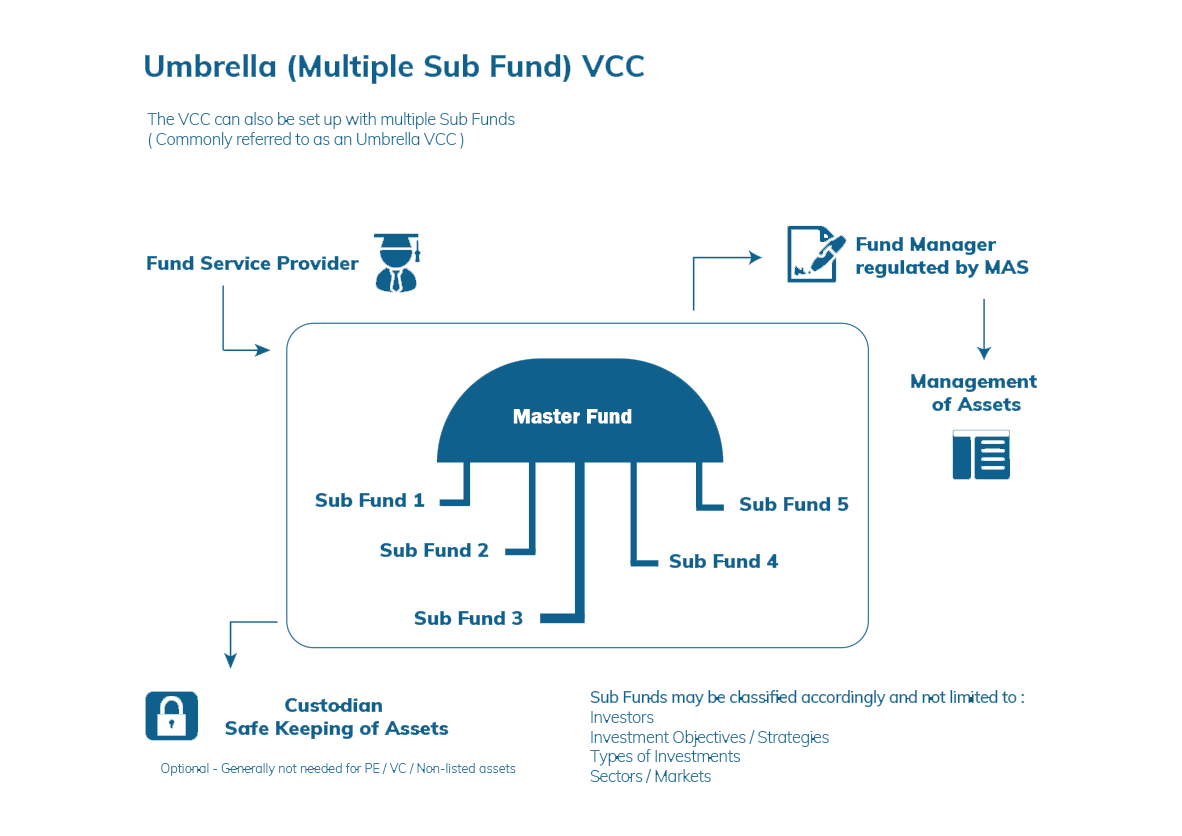
One of the most valuable features of a Singapore VCC fund is its ability to operate as an umbrella, housing multiple sub funds under a single legal entity. Each sub fund can pursue a different investment strategy, target different investors, and maintain its own separate portfolio, while sharing the same VCC umbrella for corporate governance and administrative purposes. This dramatically reduces the cost and complexity of running multiple strategies compared to incorporating an entirely separate company for each one.

Legal Segregation of Assets and Liabilities

Even though multiple sub funds can sit under one VCC, the assets and liabilities of each sub fund are legally ring fenced from every other sub fund within the same umbrella. If one sub fund runs into financial difficulty, its creditors cannot reach into the assets held by another sub fund in the same VCC, a protection that makes the umbrella structure genuinely practical rather than just administratively convenient.

Freedom to Vary Capital

Unlike an ordinary Singapore company, where reducing share capital involves a formal and sometimes cumbersome process, a VCC fund can issue and redeem shares freely, allowing it to pay dividends out of capital rather than only from accumulated profits. This flexibility matters enormously for open ended funds needing to process regular subscriptions and redemptions without navigating unnecessary corporate formalities each time.

Confidentiality of the Shareholder Register

A VCC fund is not required to make its register of shareholders public, offering a level of investor confidentiality that many fund investors specifically value, while the register itself remains accessible to regulators and relevant authorities on request.

The Regulatory Framework Behind a Singapore VCC Fund

A VCC fund must be managed by a permissible fund manager, generally a Singapore licensed or regulated entity, ensuring every VCC operates under the oversight of the Monetary Authority of Singapore even though the VCC itself is incorporated under legislation administered separately by the Accounting and Corporate Regulatory Authority, known as ACRA. VCCs are required to file an annual return within seven months of their financial year end, and audited financial statements are generally required unless the VCC qualifies as a restricted scheme with assets below a specified threshold.

A detail worth remembering. Because a VCC fund must always be managed by an MAS regulated manager, the structure cannot be used purely as a passive holding vehicle without a licensed or registered manager attached to it.

Tax Treatment of a VCC Fund

A key advantage of the umbrella structure is that tax incentive schemes such as Section 13O and Section 13U can be applied at the umbrella level rather than separately for each sub fund, simplifying the tax position considerably for managers running multiple strategies under one VCC. Qualifying VCC funds can benefit from exemptions on specified income, subject to the same conditions around minimum assets under management, local business spending, and investment professional headcount that apply to other qualifying fund vehicles in Singapore.

What a VCC Fund Typically Costs

Item Typical Cost Range
VCC umbrella incorporation A one time setup fee, plus an annual umbrella administration fee
Each additional sub fund A setup fee per sub fund, plus its own annual administration fee
Annual corporate secretarial Charged per sub fund, covering statutory filings and governance support

Exact figures vary by administrator and by the scale and complexity of the fund, so managers should request a clear, itemised fee proposal before committing to a VCC structure rather than relying on general market estimates.

Who a Singapore VCC Fund Is Actually Built For

The VCC structure suits managers running multiple strategies who want to share governance and administrative infrastructure across sub funds, hedge fund and long only managers who need the flexibility to redeem investor capital efficiently, private equity and venture capital managers who value the ability to redomicile an existing foreign fund into Singapore rather than starting from scratch, and any manager who wants a Singapore domiciled fund with a strong, purpose built legal framework behind it. The growth in VCC numbers, now representing well over a thousand incorporated vehicles and thousands of underlying sub funds, reflects just how broadly the structure has been adopted across the Singapore fund management industry.

Frequently Asked Questions

Can an existing foreign fund be moved into a Singapore VCC?

Yes. One of the more practical features of the VCC framework is the ability to re-domicile an existing foreign corporate fund into Singapore as a VCC, allowing a manager to relocate a fund’s legal home without having to unwind and rebuild it from scratch.

Does every sub fund need its own manager?

No. A single permissible fund manager can manage multiple sub funds within the same VCC umbrella, though each sub fund maintains its own separate investment strategy and portfolio.

Is a VCC only suitable for large funds?

Not necessarily. While the umbrella and sub fund structure delivers the most value for managers running multiple strategies, a standalone VCC can also work well for a single fund that simply wants the flexibility and governance benefits the structure offers.

Structuring Your Singapore VCC Fund

Auvene Operating Partners supports fund managers with VCC incorporation, sub fund setup, corporate secretarial services, and ongoing administration for Singapore VCC funds.

Contact Us


This article is for general information only and does not constitute legal, tax, or regulatory advice. VCC Act requirements, tax incentive conditions, and fee levels are subject to change, so fund managers should confirm current requirements with us or qualified legal and tax advisors before proceeding.

Singapore Family Office

A family office is an organization created to manage the wealth and investments of a high net worth family or individual. It provides a range of services such as investment management, tax planning, philanthropy, and estate planning. Singapore is an attractive location to set up a family office due to its stable economy, favorable tax policies, and business-friendly environment.

The following is a step-by-step guide to setting up a family office in Singapore:

Step 1 : Define your objectives

Before setting up a family office, it is important to determine the objectives of the office. This includes identifying the family’s current and future financial needs, goals, and priorities. This will help in determining the type of services required from the family office.

Step 2: Choose the right structure

The next step is to choose the right structure for the family office. The most common structures are a single-family office, which is created for a single family, or a multi-family office, which serves multiple families. Other options include a private trust company or a corporate entity. Each structure has its own advantages and disadvantages, so it is important to choose the one that best fits the family’s objectives.

Step 3: Determine the regulatory requirements

Family offices in Singapore are regulated by the Monetary Authority of Singapore (MAS). The regulatory requirements will vary depending on the structure of the family office. For example, a single-family office may not be required to be licensed by the MAS, while a multi-family office will require a capital market services license. It is important to seek professional advice to ensure compliance with the regulatory requirements.

Step 4: Choose the right service providers

Once the structure has been determined and regulatory requirements have been met, the family office will require the services of various professionals such as lawyers, administrators, accountants, and investment managers. It is important to choose service providers who are experienced in working with family offices and have a good understanding of the family’s objectives.

Step 5: Implement the family office

Once all the steps above have been completed, the family office can be implemented. This include establishing policies and procedures, hiring staff, and setting up systems for investment management, accounting, and reporting. It is important to ensure that the family office is structured in a way that is flexible and can adapt to changing circumstances.

In conclusion, setting up a family office in Singapore can be a complex process, but with proper planning and guidance, it can be accomplished efficiently. It is important to define the family’s objectives, choose the right structure, determine the regulatory requirements, choose the right service providers, and implement the family office. Seeking professional advice is essential to ensure compliance with regulatory requirements and the successful implementation of the family office.

Singapore Variable Capital Company VCC

Transforming a small sovereign country in Asia into a financial powerhouse

The Singaporean Variable Capital Company Act, or VCC Act, is one of the most significant developments in Asian finance to occur in recent years. Administered by the Accounting and Corporate Regulatory Authority of Singapore (ACRA), this legislation opens an entirely new world for foreign and domestic funds seeking to incorporate Asian investment instruments into their portfolios.

Offering a highly flexible fund structure, the VCC is poised to solidify Singapore’s position as the de facto financial and investment capital of Asia. First piloted in 2019 with the inclusion of 18 fund managers, the VCC Act officially went live on January 15th, 2020. Launching or redomiciling a VCC in Singapore is a straightforward process that is doable via the ACRA website. To ease the financial burden of registration, the Monetary Authority of Singapore (MAS) has launched a Variable Capital Companies Grand Scheme program.
This program will co-fund up to 70% of incorporation or registering expenses, so long as they are paid to a Singapore-based service provider.

One of the most attractive benefits of using the VCC structure is the ability to issue a fund as a stand-alone entity or an umbrella entity. The former is comprised of a single investment portfolio and is a relatively traditional format for a fund. A VCC umbrella fund is much more dynamic and allows investors to issue various segregated sub-funds, all held under the same umbrella investment fund. Part 4, Subsection 29 of the VCC Act, is one of the essential sections of the Act that touches on umbrella funds.

This section states that the segregation of sub-funds means that the liabilities are self-contained to each specific sub-fund. If one sub-fund goes under, the other sub-funds within the same umbrella fund are not affected.

Both open and closed funds are available for registration under the new VCC Act. Open-ended funds can issue an unlimited number of shares, which are generally priced daily based on the fund’s net asset value (NAV). Open-ended funds are usually more liquid and hold diversified portfolios. Close-ended funds raise a fixed amount of capital and publicly trade on secondary markets. This fund style generally entails higher yields than their open-ended counterparts and are priced more frequently than once per day. Each of these fund styles has relative pros and cons, and Singapore’s VCC Act allows investors exposure to both types.

The United States represents a significant portion of the investment world. With portfolios becoming increasingly globalized, any legal framework is well-advised to consider how to incorporate US investors with relative ease. Bringing previously off-shore capital into on-shore funds is often best accomplished using the “check the box” rules associated with IRS Form 8832. These rules allow entities to be treated by the US as “pass-through” entities, offering US investors an enticing level of inclusion. While the legislation is still young, Singapore’s VCC Act allows US investors to take advantage of this attractive election opportunity.

Investors may wish to make the permanent move and redomicile in Singapore, given its emerging status as the de facto entry point to Asian financial markets. If a company is already doing business in Singapore, redomiciling allows for complete business continuity and confers many tax benefits. It is important to note that redomiciling in Singapore is irrevocable as there are currently no provisions for entities incorporated in Singapore to redomicile overseas.

While this means redomiciling is a permanent decision, the VCC Act demonstrates that the city state’s financial environment is further liberalizing, conferring both business and legal benefits for any entities that decide to redomicile in Singapore.

If a company is already doing business in Singapore, redomiciling allows for complete business continuity confers many tax benefits.

The subject of taxation naturally entails bilateral and multilateral trade agreements, of which Singapore has many. Singapore beats out most other nations in terms of tax treaties with 86 in its jurisdiction. This amount compares to 83 tax treaties in Luxembourg, 74 in Ireland, and 37 in Hong Kong. Any potential investor must consider the tax treaty benefits conferred by incorporating or redomiciling in Singapore as a second-order benefit. The OECD’s Base Erosion of Profit Shifting (BEPS) initiative focuses on eradicating predatory tax rate shopping by international corporations, and Singapore is a dedicated signer of this initiative. Notwithstanding this further demonstrates the veracity of the VCC Act and Singapore’s earnest approach to confidently stepping up to the plate as the new financial doorway to Asia.

The VCC Act takes the best aspects of other tax havens’ financial frameworks and optimizes them Singapore’s unique situation. This Act comes at a near-perfect time as the city-state is poised to receive massive investment from off-shore funds seeking to redomicile as on-shore entities due to geopolitical uncertainties. Many considerations must be taken into account before a company decides to expand into a new legal jurisdiction.

However, with Singapore’s dedication to Common Law, near-perfect position in the Strait of Malacca, and increasing economic liberalization, one would be hard-pressed to find a better candidate for foreign investment.


Digital Future

Blueprint of a Digital Tech Hub

Observing the rapid evolution of the Southeast Asian landscape, it is clear that Singapore has transcended the traditional definition of a “tech hub.” In 2026, the city-state is no longer just a gateway for capital; it has become the world’s living laboratory for Smart Nation 2.0. By shifting focus from mere digitalization to a philosophy of Trust, Growth, and Community, Singapore is providing a global masterclass in navigating the “Intelligent Economy.”

The Rise of Industry 5.0 and Scaled AI

The narrative in 2026 has moved past experimental AI pilots toward production-scale deployment. Singapore’s strategic focus on Industry 5.0—which harmonizes human creativity with high-speed machine precision—is most evident in its industrial zones. The launch of the National AI Impact Programme (NAIIP) aims to support 10,000 enterprises, specifically targeting the “messy middle” of SMEs to ensure the digital divide doesn’t become a digital chasm.

At the heart of this is “Kampong AI” in one-north, a dedicated AI park where the government, startups, and MNCs co-locate to turn theoretical models into real-world applications in healthcare, finance, and advanced manufacturing.


A Talent Strategy Defined by “AI Bilingualism”

Market data indicates a structural shift in the labor force. The goal is no longer just “coding for all,” but AI Bilingualism. Singapore is currently training 100,000 workers to be fluent in both their domain expertise (e.g., law, accounting, or logistics) and AI orchestration.

Priority SectorKey Technology DriverWorkforce Shift
ManufacturingQuantum Computing & RoboticsPrecision Engineering 2.0
FinanceWeb3 & Asset TokenizationProgrammable Trust
SustainabilityESG Analytics & Green TechDecarbonization Management

This “skills-first” economy, bolstered by the TeSA (TechSkills Accelerator) initiative, ensures that the workforce remains the most “plug-and-play” talent pool in Asia-Pacific.


Trust as a Competitive Commodity

In an era of deepfakes and sophisticated cyber threats, Singapore has identified Trust as its most valuable export. The Digital Infrastructure Act (DIA), introduced in 2025, has now fully matured, mandating rigorous resilience standards for data centers and cloud providers.

By positioning itself as a “Trust-based Services Hub,” Singapore attracts global giants not just for its tax incentives, but for its regulatory certainty. The Model AI Governance Framework has become a de facto template for the region, allowing companies to innovate within a “safety-first” sandbox.

The Johor-Singapore Special Economic Zone

Looking outward, Singapore’s digital future is inextricably linked to the Johor-Singapore Special Economic Zone (JS-SEZ). By 2026, this corridor has become a seamless digital hinterland. Companies use Singapore as the “brain”—for R&D, IP protection, and regional HQ functions—while leveraging the broader region for scalable manufacturing and data infrastructure.

Beyond the Screen

Singapore’s journey suggests that a true technology hub is not measured by the number of apps developed, but by how seamlessly technology disappears into the fabric of daily life. As we look toward 2030, the “Singapore Model” is one where innovation is aggressive, but the social compact—ensuring no citizen is left behind in the transition—remains the ultimate benchmark of success.


Redomiciliation

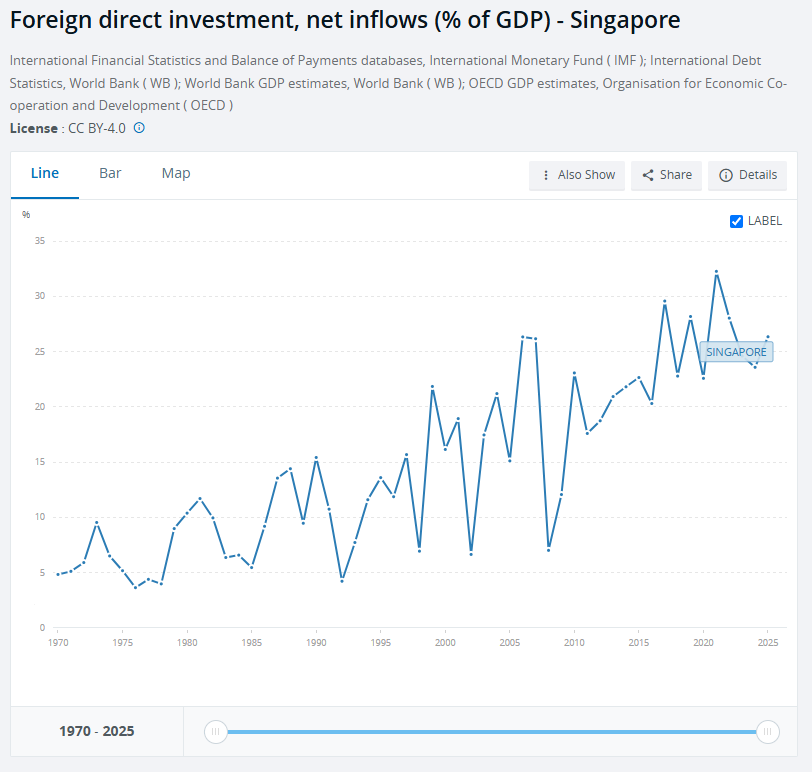
data.worldbank.org

Guide · Family offices in Singapore

Redomiciliation to Singapore family offices

Moving a family office structure to Singapore does not have to mean starting over. Redomiciliation lets an entity keep its history while gaining a new home. Here is how the process works.

Families managing wealth across several jurisdictions eventually face the same question. Should the holding structure stay where it was first set up, or should it move closer to where the family actually lives, invests, and plans for succession. For a growing number of families, the answer is Singapore, and the mechanism that gets them there without disrupting existing contracts, banking relationships, or corporate history is redomiciliation.

What redomiciliation actually means

Redomiciliation is a transfer of registration, not a liquidation and restart. A foreign corporate entity moves its place of incorporation to Singapore while remaining, in legal substance, the same entity. Contracts stay in force, assets and liabilities carry over, and the company’s track record moves with it. This matters for a family office, since banking relationships, credit history, and existing agreements do not need to be rebuilt from scratch.

Once the transfer completes, the entity is fully subject to Singapore law, including its tax rules, corporate governance requirements, and reporting obligations under ACRA and IRAS. There is no route back. Singapore’s regime does not currently allow an entity to redomicile out again to its original jurisdiction, so this is a considered, one way move rather than a trial run.

Why Singapore is the destination of choice

Singapore’s appeal for family offices rests on a few consistent pillars. Political and regulatory stability gives multi generational planning a firmer foundation. A deep private banking and wealth management ecosystem means the professional infrastructure, from custodians to legal counsel, is already in place. A competitive tax regime, paired with an extensive treaty network, gives structuring options that many other jurisdictions cannot match. And MAS provides a clear, well understood regulatory framework for family offices, which reduces the ambiguity that families often encounter elsewhere.

Who qualifies to redomicile

Not every entity is eligible. Singapore’s inward redomiciliation regime, introduced through the Companies Act, is built for established operating entities rather than dormant shell companies. To qualify, a foreign corporate entity generally needs to meet at least two of the following three conditions.

Total assets

The entity’s total assets exceed S$10 million.

Annual revenue

The entity’s annual revenue exceeds S$10 million.

Headcount

The entity employs more than 50 people.

Where the applicant is a parent company, these criteria are assessed on a consolidated group basis. The entity must also be solvent, able to pay its debts as they fall due, and able to show that its assets are not less than its liabilities, including contingent ones. A solvency statement from the directors, along with certified financial statements and constitutional documents, forms part of the application to ACRA.

These thresholds and family office tax conditions have been revised more than once in recent years. Always confirm the current figures with MAS and a qualified tax advisor before relying on them for planning purposes.

Auvene Fund Administration Services

Considering a move to Singapore

Auvene helps families assess whether redomiciliation or a fresh incorporation is the better fit, then manages the process from application through to ongoing administration.

Talk to Auvene

Where the family office structure fits in

For most families, the redomiciled entity is not the family office itself. It is usually the holding company or fund vehicle that sits above the investment portfolio, with a separate Singapore fund management company acting as the family office beneath it. That fund management company typically applies for tax exemption on qualifying investment income under Section 13O or Section 13U of the Income Tax Act, depending on the scale of assets under management and the complexity of the structure.

Both schemes carry conditions around minimum assets under management, the number of Singapore based investment professionals employed, annual local business spending, and, in many cases, a minimum amount of capital deployed into Singapore linked investments. These conditions have tightened over the past few years, and MAS reviews approved family offices on an ongoing basis rather than at a single point in time. Getting the structure right at the outset, and keeping it compliant afterward, is a genuine, continuing exercise rather than a one time filing.

Supporting the move

Redomiciliation and family office set up both involve a sequence of interdependent steps, and getting the order wrong can cost months. We can works alongside families and their existing advisors across the full arc of the process.

  • Structuring assessment. Reviewing whether redomiciliation, a new Singapore incorporation, or a VCC structure best fits the family’s existing entities and long term goals.
  • Application management. Coordinating the ACRA transfer of registration filing, solvency documentation, and supporting financial statements.
  • Family office formation. Setting up the Singapore fund management company, supporting the 13O or 13U application, and helping identify and onboard the required investment professionals.
  • Corporate secretarial and governance. Acting as company secretary, maintaining statutory registers, and supporting board and family governance processes.
  • CDD and investor onboarding. Running the AML and KYC checks that MAS expects to see in place from day one.
  • Ongoing administration. Handling accounting, financial reporting, regulatory filings, and the annual reviews that MAS conducts on approved family offices.

For families with existing structures in the Cayman Islands, the British Virgin Islands, or Hong Kong, Auvene also coordinates across jurisdictions, so a Singapore family office sits comfortably alongside offshore vehicles rather than creating duplicated compliance work.

Institutional rigour. Boutique accountability.

Planning a family office redomiciliation to Singapore

Auvene guides families through structuring, application, and ongoing administration, with professional partners with senior attention at every stage.

Chat with us on WhatsApp


This guide is for general information only and is not legal or tax advice. Please speak to us or a qualified counsel and MAS directly before making structuring decisions.